
 Recently I was contacted about a comment I made concerning the "world's first interactive video game" that has now been attributed to Bill Gates (Billy Ingram - Bill Gates - close enough, right?).
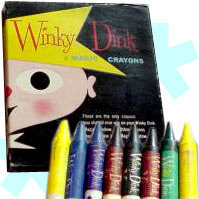
I was kidding when I wrote in 1994 that the distinction belongs to 'Winky Dink and You', a TV show from the mid-1950s that asked kids to draw a bridge (or a car, whatever) on a Magic Screen to help Winky escape the villain. It gave the illusion of being interactive, children bought into it 100% - ask any boomer who remembers the series and you'll get a tremendous look of excitement.
Of course, there was nothing the user could do that would really change the outcome of the game. Here's one of the shows... it was revived briefly in 1969. You can read more here about Winky Dink & You.
No one to my knowledge has ever written about the actual first modern interactive video game that went beyond Pacman-like animation, I just happened to have worked on the project 30 years ago this year. Produced for the Walt Disney Telecommunications and Non-Theatrical Company by Bosustow Entertainment in September 1983 it was called 'The Disney Disc of Fantasy and Magic'. Stephen Bosustow was one of the founders of UPA Studios, they produced those Emmy winning Mister Magoo cartoons along with many other faves like Gerald McBoing Boing.
In 1963 he went out on his own and formed an animation house with his son Nick. In 1970 they produced a cartoon version of 'The Legend of Sleepy Hollow' with John Carradine starring; 1978 they animated the children's story 'Tom Thumb' for television with voices provided by June Foray and Hans Conried. Bosustow also employed the vocal talents of Louis Nye, Don Messick, Stan Freberg, Claire Bloom, James Earl Jones, Michael York, and many other entertainment giants. In the 1980s they were providing content for 'CBS Library', winning the Emmy in 1983 for 'Wrong Way Kid' starring Dick Van Dyke.
Though Bosustow was an animation house, 'The Disney Disc of Fantasy and Magic' was a live action shoot. It was centered around a wizard who ran a haunted hotel and his assistant, an ape (obviously a guy in a costume). At different junctures in the 30 minute game the kids would be given three hotel room doors to choose from, that would determine the next chain of events.
Because of the limited space on a Laser Disc there weren't really that many pre-determined outcomes so the game never really caught on. At least that's my theory, to be honest I don't know for sure if it was ever released... who had a laser disc machine?
I was the prop master for the project, creating the door exteriors and other things. When I went for my first meeting the Bosustow studio had rows of animation desks in a large open studio that all sat empty, I was asked to man one of those desks to make it look like the studio was still operating when the director got there. In fact, there were no active animation projects in house.
That was when I met with the director, the famed Norman Abbott, who directed everything from 'The Munsters' and 'Leave it to Beaver' to 'Alice'. What a nice guy he was, such a pleasure to work with, whatever weird stuff would happen on the set he could adapt at a moment's notice. (Everyone was convinced the project was cursed and I heard later that Disney took so long to pay Bosustow's invoices that they went out of business.)
I hired one of Bosustow's freelancers to create illustrated cards featuring the requisite Disney characters (like Snow White) that had to be drawn 'on model'... in other words they had to be correct in terms of the character's designs. Whoever the artist was she was pitch-perfect. The production was filmed on a soundstage at CBS Television City in Hollywood.
The effects guy / art director on the film was Peter Knowlton. I had just worked with him on the special effects for 'Cujo', that's another wild story I'll have to tell (I was almost Cujo in the film).

Above is a still from 'The Disney Disc of Fantasy and Magic', (I can't find the original, this is a 1980s photocopy so it's a bit murky). The folks at Disney were so nice they sent everyone who worked on the project a snapshot and a personalized letter of recommendation. Who does that?!? What I recall most is what a class act Stephen and Nick Bosustow were, in a business full of sharks and low lifes they stood out to me.


 After a decade of bombing in comedy clubs Rodney Dangerfield made a splash on TV with an appearance on The Ed Sullivan Show in the 1960s. Before long he became known for his "I Don't Get No Respect" routine, a genius hook for a comedy bit.
 ABC was number 1 in daytime, including 'Funshine Saturday', and in primetime thanks to Happy Days. Here's a fall preview of their new daytime programs for 1974, one Saturday show was based on a prime-time hit of the past.
 Metromedia offered him a local weekly LA slot and a nationally syndicated 90 minute program in 1965 filmed at the KTTV-11 (now FOX-11) studios, located in the former Metromedia Square. The show was a hit with young people and old cranks alike, it took a few years but the talk show became one of the hottest programs in syndication.
 When did this all start? Perhaps at the very beginning of recorded history - the nifty fifties. Cowboys like Gene Autry, Hopalong Cassidy and The Lone Ranger were the hottest properties on television, after watching these programs all afternoon kids naturally wanted to play shoot-em-up at home.
  When western wranglers and pistol-waving cops started to lose favor in the early-'60s, toy gun lines lost their key salespersons and innovative products had to be created from scratch.

